How Potential Clients Are Using AI to Find Attorneys — And Why Your Law Firm May Be Invisible

How Potential Clients Are Using AI to Find Attorneys — And Why Your Law Firm May Be Invisible
Potential clients are no longer relying on one simple Google search to choose an attorney. Increasingly, they are asking AI tools to explain their legal problem, identify the type of lawyer they need, compare options, and narrow down which firms appear trustworthy enough to contact.
That shift matters for every solo attorney and small law firm. A firm can have a professional website, a solid Google Business Profile, and respectable organic rankings, yet still be absent when someone asks ChatGPT, Google AI Mode, Gemini, or another AI assistant for help finding a lawyer. That is why law firm AI visibility has become a separate question from traditional SEO.
The opportunity is not to chase a new trick or rewrite your entire website for machines. Instead, small firms need to understand how AI tools assemble answers, why they trust some sources more than others, and what makes a law firm easy to identify, describe, and recommend.
Quick Answer: How Are Potential Clients Using AI to Find Attorneys?
Potential clients are using AI to research legal issues, compare practice options, understand likely next steps, and identify attorneys who appear relevant to their location and situation. AI systems do not simply display a ranked list of websites. They synthesize information from multiple sources, which means a law firm may need clear website content, strong local signals, credible third-party references, and consistent business information to appear in the answer.
In other words, ranking well on Google still matters, but it is no longer the only visibility test. A small law firm also needs to be understandable and verifiable across the broader web.
What Does the New Client Search Journey Look Like?
A traditional attorney search often followed a familiar path. Someone typed a phrase such as “divorce attorney near me,” scanned a map pack, opened several websites, read a few reviews, and made a call.
That process still happens. However, AI adds an earlier research layer. A potential client may first ask, “What type of attorney do I need if my business partner locked me out of the company?” Another person may ask, “What should I look for in a Michigan criminal defense lawyer?” A third may ask an AI assistant to compare several firms by experience, location, reviews, communication style, or likely fit.
By the time that person reaches Google or your website, AI may have already shaped the shortlist.
This changes the role of your website. It is still a conversion tool, but it is also a source that machines may use to understand who you are. The same is true of your Google Business Profile, attorney biographies, reviews, directory listings, news mentions, bar profiles, and other credible references.
AI is often answering questions before recommending firms
Most AI-assisted searches begin with education, not a direct request for a lawyer. The user asks what a legal term means, whether an issue is serious, what may happen next, or what type of attorney handles it. Firms that publish clear, specific, useful explanations have a better chance of becoming part of that research process.
This is one reason generic content is losing value. A broad article that merely defines “probate” or “white-collar crime” may not add enough original context to distinguish one firm from another. A page that explains what clients commonly misunderstand, how a matter is handled locally, what documents may matter, and when legal help becomes urgent is much more useful.
Why Might a Well-Ranked Law Firm Still Be Invisible in AI Answers?
Traditional search rankings and AI recommendations overlap, but they are not identical. Search engines often return a list of pages that best match a query. AI tools attempt to produce a direct answer using information gathered from multiple sources.
That difference creates several visibility gaps.
Your website may not clearly explain what makes the firm relevant
Many law firm websites use language that sounds polished but says very little. Phrases such as “aggressive representation,” “personalized service,” and “results-driven advocacy” appear on thousands of sites. They do not help an AI system understand which cases you handle, where you practice, or why you may be a strong fit for a specific client.
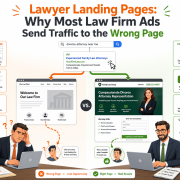
A clearer site states exactly who the firm helps, the problems it handles, the courts or regions it serves, and what clients can expect. That same clarity also improves conversion rates, which is why the fundamentals in why most small law firm websites do not generate calls are closely connected to AI visibility.
Your firm may lack corroboration outside its own website
A website can make many claims about itself. AI systems are more likely to trust information that can be confirmed elsewhere. Consistent directory profiles, genuine client reviews, professional biographies, local media mentions, court-related publications, bar listings, and other independent references can help establish that the firm is real and that its stated focus is credible.
This does not mean buying dozens of low-quality directory listings. It means building a consistent, verifiable identity across sources that matter.
Your content may be too generic to cite
AI tools need passages that answer specific questions cleanly. A 2,000-word article can still be hard to use if every section is vague. Strong question-based headings, concise explanations, local context, and clear distinctions make content easier to extract and summarize.
That is also why the structure of a complete attorney marketing guide matters. Topic completeness helps both people and machines understand how individual ideas fit together.
What Signals Help AI Systems Understand a Law Firm?
No one outside the platforms knows every factor used by every AI system, and firms should be skeptical of anyone promising guaranteed placement. Still, several practical signals consistently improve a law firm’s overall digital credibility.
First, the firm needs a clear entity identity. The attorney’s name, firm name, location, phone number, practice areas, and biography should be consistent across the website and reputable third-party profiles.
Second, the website needs focused service pages. A strong practice-area page explains more than the legal definition. It identifies the client’s problem, the firm’s role, the likely process, and relevant local considerations. The same principle applies to geographic pages, although those pages must contain real local context rather than repeated city names.
Third, the firm needs evidence of experience and trust. Reviews, detailed biographies, case-related insights, speaking engagements, articles, and community involvement can all help. The goal is not to manufacture authority. It is to make real experience visible.
Finally, the website should be technically accessible. Slow load times, broken pages, confusing navigation, missing metadata, and weak internal linking make content harder for both users and automated systems to interpret. A website and SEO review can help identify these gaps before a firm starts investing in more content.
Does schema markup guarantee AI visibility?
No. Structured data can help search engines interpret information, but it does not replace substance. Adding attorney, organization, local business, article, and FAQ schema may improve clarity when implemented correctly. However, schema cannot make thin content authoritative or turn inconsistent business information into a trusted entity.
Google’s own structured data documentation emphasizes that markup helps systems understand page content. It should be viewed as a support layer, not a shortcut.
How Can a Small Law Firm Check Its Current AI Visibility?
The simplest starting point is to test the kinds of questions a potential client might ask. Avoid searching only for your firm name. Instead, ask broader questions that reflect actual client intent.
For example, a Michigan family law firm might test questions about choosing a divorce attorney, finding a lawyer for a complex custody matter, or understanding which local firms handle high-conflict cases. A business firm might test questions about contract disputes, partner conflicts, or outside general counsel services.
Run variations across more than one platform. Results can differ between ChatGPT, Google AI Mode, Gemini, Perplexity, and other tools. Also remember that AI answers can change, personalize, or use different sources over time.
When reviewing the answers, look for four things: whether your firm appears, which competitors appear, what sources are cited, and how those competitors are described. That competitive context is often more valuable than a simple yes-or-no visibility check.
Your analytics can also reveal AI referral traffic. Proper GA4 tracking may show visits from AI assistants, although attribution is still imperfect. LuckyFish Media’s law firm lead-tracking guidance explains why firms should connect traffic sources to actual calls, consultations, and hires rather than relying on visibility metrics alone.
What Should Small Law Firms Do First?
Start with the fundamentals rather than publishing dozens of AI-focused articles.
Make sure your homepage and primary service pages clearly state who you help, what you handle, and where you work. Strengthen attorney biographies with real experience, not just credentials. Review your Google Business Profile, major professional listings, and online reviews for consistency. Then identify the client questions your current content does not answer well.
Next, build a focused content plan. The goal is not to produce generic articles at scale. It is to create useful pages that reflect real consultations, local conditions, and the firm’s actual experience. The approach described in why AI is making generic law firm content almost worthless is the natural next step.
Finally, measure what matters. Visibility is valuable only if it contributes to qualified inquiries. A firm should monitor referral sources, calls, forms, consultations, and retained matters. That is also why a strong website, local SEO, and thoughtful Google Ads strategy for attorneys remain important. AI visibility belongs inside a larger marketing system.
Frequently Asked Questions About AI Attorney Search
Can a law firm pay to appear in ChatGPT recommendations?
Organic AI recommendations are not the same as paid advertisements. Some AI platforms may offer advertising products, but firms should not assume that paying for ads will create organic recommendation authority. Paid visibility and earned visibility should be evaluated separately.
Will AI replace Google searches for lawyers?
Probably not entirely. More likely, AI will become another layer in the research process. People may use an AI assistant to understand the issue and narrow options, then use Google Maps, reviews, and firm websites to verify the decision.
Does a law firm need a separate AI SEO strategy?
A separate review can be helpful, but the strongest improvements usually reinforce traditional SEO as well: clearer content, stronger trust signals, better local relevance, consistent business information, and useful third-party references.
How quickly can AI visibility improve?
There is no guaranteed timeline. Some changes may be reflected quickly, while others depend on crawling, indexing, third-party references, and broader authority. The firm should think in months, not days.
Final Summary
Potential clients are already using AI to understand legal issues and evaluate attorneys. That means small law firms now need to be visible in more places than a traditional search-results page.
The firms most likely to benefit are not necessarily the largest. They are the firms that clearly explain what they do, provide useful and specific content, maintain consistent information across trusted sources, and make real experience easy to verify.
AI visibility is not a replacement for SEO, a strong website, or local marketing. It is the next layer of the same credibility system.
Find Out Whether Your Law Firm Is Visible in AI Search
LuckyFish Media offers a Law Firm AI Visibility & Website Review for solo attorneys and small firms that want a practical look at how they appear across search, AI tools, their website, and local results.
The review identifies competitors that are appearing where your firm is not, highlights website and content gaps, and provides a prioritized roadmap rather than a vague score. To discuss your firm’s visibility, contact LuckyFish Media.
General informational disclaimer: This article provides general marketing and technology information for law firms. It is not legal advice, ethics advice, or a guarantee of search or AI visibility. Platform features and results can change over time.