
What Should a Law Firm Marketing Agency Actually Do for Your Firm?
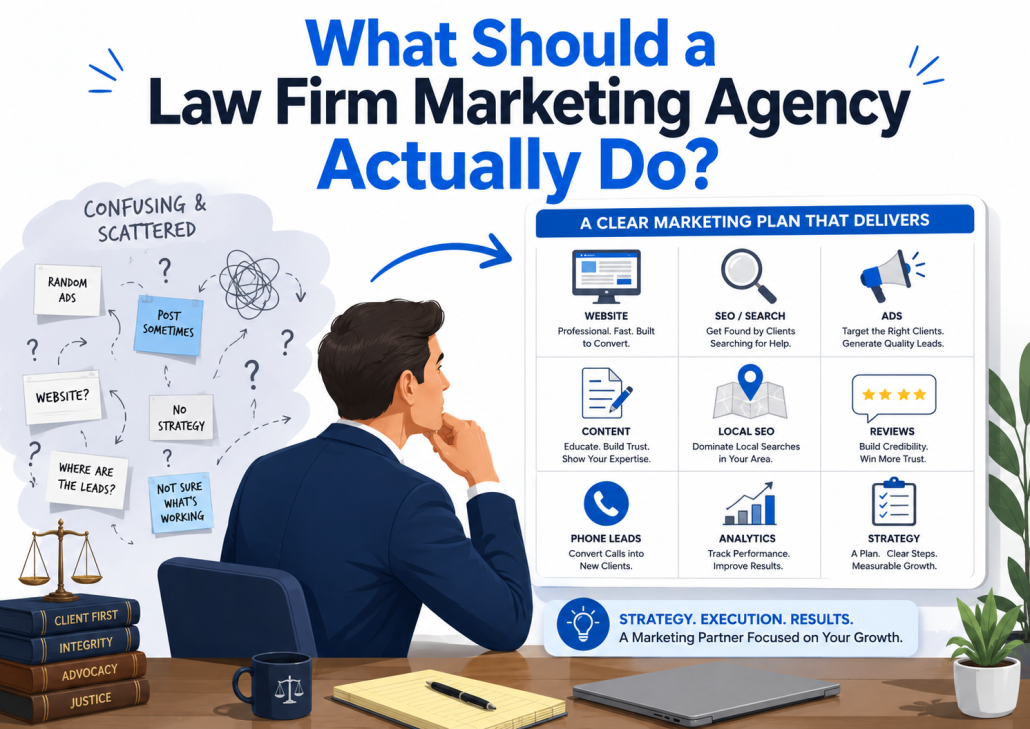
What Should a Law Firm Marketing Agency Actually Do for Your Firm?
Hiring a law firm marketing agency should make your life easier, not more confusing.
Unfortunately, many attorneys sign up with a marketing company and are never completely sure what is being done, why it matters, or whether the work is actually helping the firm get better cases.
You may receive monthly reports filled with rankings, clicks, impressions, traffic charts, and campaign data. But the real question is much simpler:
Is your marketing helping your law firm get more of the right calls, leads, consultations, and clients?
That is what a good law firm marketing agency should be focused on.
A marketing agency for attorneys should not just “do SEO” or “run ads.” It should help your firm build a stronger online presence, attract better-fit potential clients, track what is working, and make smarter decisions about where your marketing dollars should go.
At LuckyFish Media, I work with solo attorneys and small law firms that often need practical help with websites, SEO, Google Ads, content, local search, and tracking. The goal is not to overwhelm attorneys with marketing jargon. The goal is to help them understand what is working, what is not, and what to do next.
Quick Answer: What Should a Law Firm Marketing Agency Do?
A law firm marketing agency should help your firm get more qualified leads by improving your website, SEO, Google Business Profile, content, advertising, tracking, and overall online visibility.
At a minimum, your agency should help with:
- Making your website clearer and easier to use
- Improving your visibility in Google search
- Helping your firm show up for the right legal services and locations
- Creating helpful content that answers real client questions
- Managing or advising on Google Ads when paid traffic makes sense
- Tracking phone calls, contact forms, and other important lead actions
- Reviewing results and recommending next steps
- Explaining everything in plain English
A good agency should not hide behind confusing reports or vague marketing language. You should understand what is being done and how it connects to your law firm’s goals.
Marketing Should Start With Your Firm’s Actual Goals
Before an agency works on rankings, content, ads, or website updates, it should understand what your law firm is trying to accomplish.
Not every law firm needs the same marketing strategy.
A solo divorce attorney may need better local visibility in one city. A criminal defense firm may need stronger Google Ads and faster call tracking. An estate planning attorney may need educational content that builds trust over time. A personal injury firm may need a more competitive SEO and paid search strategy.
Your agency should ask questions like:
- What types of cases do you want more of?
- Which cases do you want less of?
- What cities or counties matter most?
- Are you trying to grow quickly or steadily?
- Do you want more phone calls, form submissions, consultations, or referrals?
- Are you already getting leads that are not a good fit?
- What has worked or failed in the past?
Without these answers, marketing becomes guesswork.
A good law firm marketing agency should not simply chase traffic. It should help your firm attract the right people for the right services in the right locations.
This is also why a general marketing checklist is rarely enough. Your firm’s plan should be tied to your practice area, market, budget, timeline, and capacity to handle new leads.
Key Takeaways
- A marketing plan should be based on your firm’s goals, not a generic checklist.
- More traffic is not always better if the leads are poor quality.
- Your agency should understand your practice areas, service area, and ideal client.
Your Website Should Be Clear Before Anything Else
Your website is usually the center of your law firm’s marketing.
Even if someone finds you through Google, Google Ads, your Google Business Profile, a referral, or social media, they will often visit your website before contacting your office.
That means your website needs to answer a few important questions quickly:
- What type of law do you practice?
- Where do you help clients?
- Why should someone trust you?
- What should a potential client do next?
- How easy is it to call or contact your office?
A law firm website does not need to be flashy to be effective. In many cases, clear beats clever.
Your homepage should make it obvious who you help and what you do. Your practice area pages should explain your services in plain English. Your contact information should be easy to find. Your calls to action should be clear without sounding pushy.
A marketing agency should regularly review your website and look for issues that may be hurting leads, such as:
- Confusing headlines
- Weak calls to action
- Pages that are too thin
- Service pages that do not explain enough
- Location pages that feel generic
- Slow-loading pages
- Missing tracking
- Contact forms that are hard to use
- Pages that attract the wrong type of lead
For law firms, the website is not just a brochure. It is often the first serious trust test.
If the site feels outdated, unclear, or generic, potential clients may leave and contact another attorney. I covered this in more detail in Why Most Small Law Firm Websites Don’t Generate Calls and What a Solo Law Firm Website Actually Needs in 2026.
Key Takeaways
- Your website should quickly explain who you help, what you do, and how to contact you.
- Clear writing and strong service pages matter more than flashy design.
- Your agency should review your website as a lead-generation tool, not just a design project.
SEO Should Focus on Visibility That Can Turn Into Cases
Search engine optimization is one of the main reasons attorneys hire a marketing agency.
But SEO for law firms should not be reduced to chasing random rankings.
A law firm can rank for a keyword that never produces a good lead. Another firm may rank lower for a broader term but still get more calls because the page is more useful, the location is better, or the visitor is more ready to contact an attorney.
Good SEO should focus on visibility that supports real business goals.
That includes:
- Practice area pages for your most important services
- Location-focused pages when they make sense
- Helpful blog posts that answer common client questions
- Internal links between related pages
- Clear title tags and meta descriptions
- Google Business Profile optimization
- Strong website structure
- Helpful, original content
- Ongoing review of Google Search Console data
Google’s own SEO guidance emphasizes creating helpful, reliable, people-first content while still using SEO best practices to help search engines discover and understand your pages. You can read Google’s guidance here: Creating helpful, reliable, people-first content.
For attorneys, SEO is often a long-term strategy. It can take time to build enough trust, content, and authority to compete. This is especially true in competitive practice areas like divorce, criminal defense, personal injury, estate planning, and business law.
Your agency should be able to explain what keywords matter, which pages are improving, what content needs to be created, and where opportunities exist.
They should also be honest when rankings move.
Google rankings are not perfectly stable. Search results can shift because of algorithm updates, competitors making changes, location differences, search intent, or even how Google is testing results. One keyword moving up or down does not always mean the entire strategy is working or failing.
The bigger picture matters more.
Are impressions increasing? Are important pages getting more visibility? Are calls and forms improving? Are the right practice areas gaining traction? Are potential clients finding useful pages?
That is what your law firm should be watching.
For more background, you may also find these helpful:
- Law Firm SEO: A Beginner’s Guide for Attorneys Who Don’t Have Time
- Search Engine Optimization for Lawyers
- SEO for Law Firms: What Google Really Looks For
Key Takeaways
- SEO should focus on leads and useful visibility, not vanity rankings.
- Practice area pages, location pages, and helpful content all work together.
- Ranking movement is normal, so your agency should explain trends instead of overreacting to one keyword.
Content Should Answer the Questions Potential Clients Are Already Asking
A good law firm marketing agency should help you create content that is useful, accurate, and written for real people.
This does not mean publishing generic blog posts just to say something was added to the website.
Good legal content should answer the questions potential clients are already asking before they contact an attorney.
For example:
- What happens after someone is charged with a crime?
- How does child custody work in Michigan?
- What should someone do after a car accident?
- When should someone update an estate plan?
- What are the first steps in a divorce?
- How much does it cost to hire an attorney?
- What mistakes should someone avoid?
This type of content can help your firm in several ways.
It can improve search visibility. It can build trust. It can help potential clients understand their situation. It can support your main service pages. It can also give your firm something useful to share in emails, social posts, and consultations.
However, the content should sound like your firm. It should not feel like it was copied from every other law firm website.
A good agency should help you create content that is:
- Clear
- Helpful
- Local when appropriate
- Easy to read
- Connected to your services
- Accurate enough to build trust
- Written in a tone that fits your firm
For attorneys, content is not just about ranking. It is about helping the right person feel confident enough to call.
I talk more about this in Content Marketing for Attorneys and Attorney Marketing: The Ultimate Guide to Growing Your Firm.
Key Takeaways
- Legal content should answer real client questions.
- Blog posts should support your main service pages and business goals.
- Helpful, original content is more valuable than generic posts written only for search engines.


